Hooded
Oriole, Icterus cucullatus

Hooded Orioles often nest in fan palm trees, particularly of genus Washingtonia, like the one in the photo above; they weave their hanging nests from threads of fiber taken from the fronds of this tree. These trees are not native to Northern California where this bird was photographed, but have been widely planted there for decorative purposes and then have attracted birds of this beautiful species northward from their southwestern habitat. Below, an adult male Hooded Oriole in full profile, photographed in southeastern Arizona.


Above and below, adult female Hooded Orioles, characterized by dull yellow, gray, and olive plumage. Some females have a few black feathers on the throat like the one below.

Above an adult female and below an immature male Hooded Oriole, both at my back yard hummingbird feeder on the Stanford campus. Orioles like the the same sugar water that attracts hummingbirds.

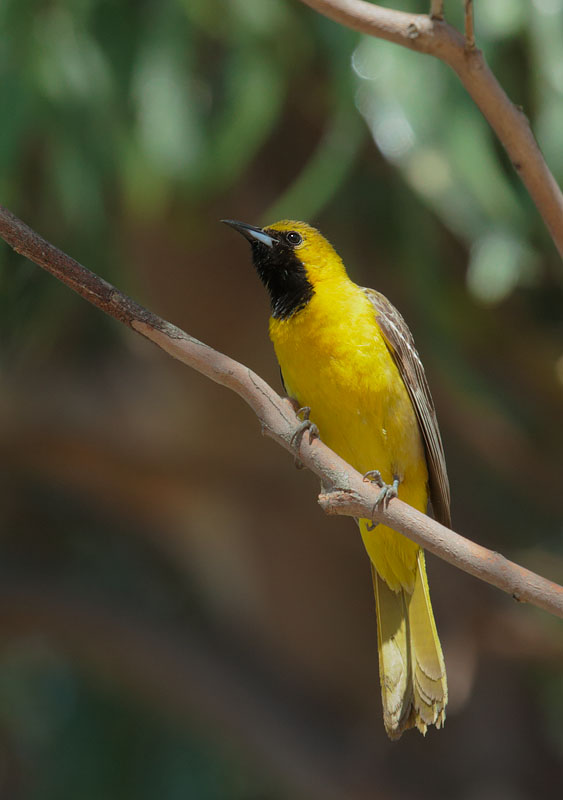
Above and the two below, yearling males, resembling adult females but distinguished by the partial black bib on the throat. Female
and immature male Hooded Orioles can be confused with their counterparts among Bullock's and Orchard Orioles; latter species
both distinguished, among other things, by bills that are shorter and less decurved.


This bird, photographed in my home area, Santa Clara County, California, is identifiable as a juvenile by the fresh plumage in late summer, wingbars buffy rather than white, and by the pink color at the base of the bill, as well as the prominent rictal flanges, diagnostic of juveniles of many species. Hooded Orioles mostly migrate from Northern California in early September, when this photograph was taken.

Above and below, more views of the spectacular adult male Hooded Oriole.
